

What Patients Actually Experience Between Appointments: A brite™ Platform Use Case
The Question Most Healthcare Systems Cannot Answer
What actually happens to a patient between appointments? Not in theory. Not in a clinical protocol. In real life, on a Tuesday evening, when a symptom feels unfamiliar and there is nobody credible to call.
For most pharma and MedTech companies, that question has no structured answer. The data simply does not exist in any form that is reliable, continuous, or actionable. And yet everything that determines whether a therapy succeeds or fails in the real world happens in exactly that space, in the daily decisions patients make about whether to keep taking a medication, whether a side effect is serious enough to worry about, and whether the therapy is actually making their life better or not. That absence of data is not just a clinical gap. It is a commercial one, and it is the reason payers and HTA bodies are increasingly asking harder questions about what a therapy actually delivers in daily life rather than in a controlled trial setting.
This use case draws on fully anonymised, patient-reported data collected through brite™ across a chronic digestive condition therapy space, showing what continuous digital patient engagement reveals that clinical assessments were never designed to capture.
All data has been fully anonymised and de-identified. No reference back to individual patients or specific client projects is possible. N = approximately 260 enrolled patients. Reference year 2026.
The Patients Behind the Data
Behind every data point in this use case is a person managing a condition that shapes their daily life in ways a clinical record rarely reflects. The cohort is predominantly female at 71% and concentrated in the 40 to 59 age bracket, consistent with the demographic patterns of chronic digestive conditions. 48% record a normal BMI, with overweight and obese patients together accounting for around 41%, a profile consistent with the comorbidity patterns seen across chronic disease populations.
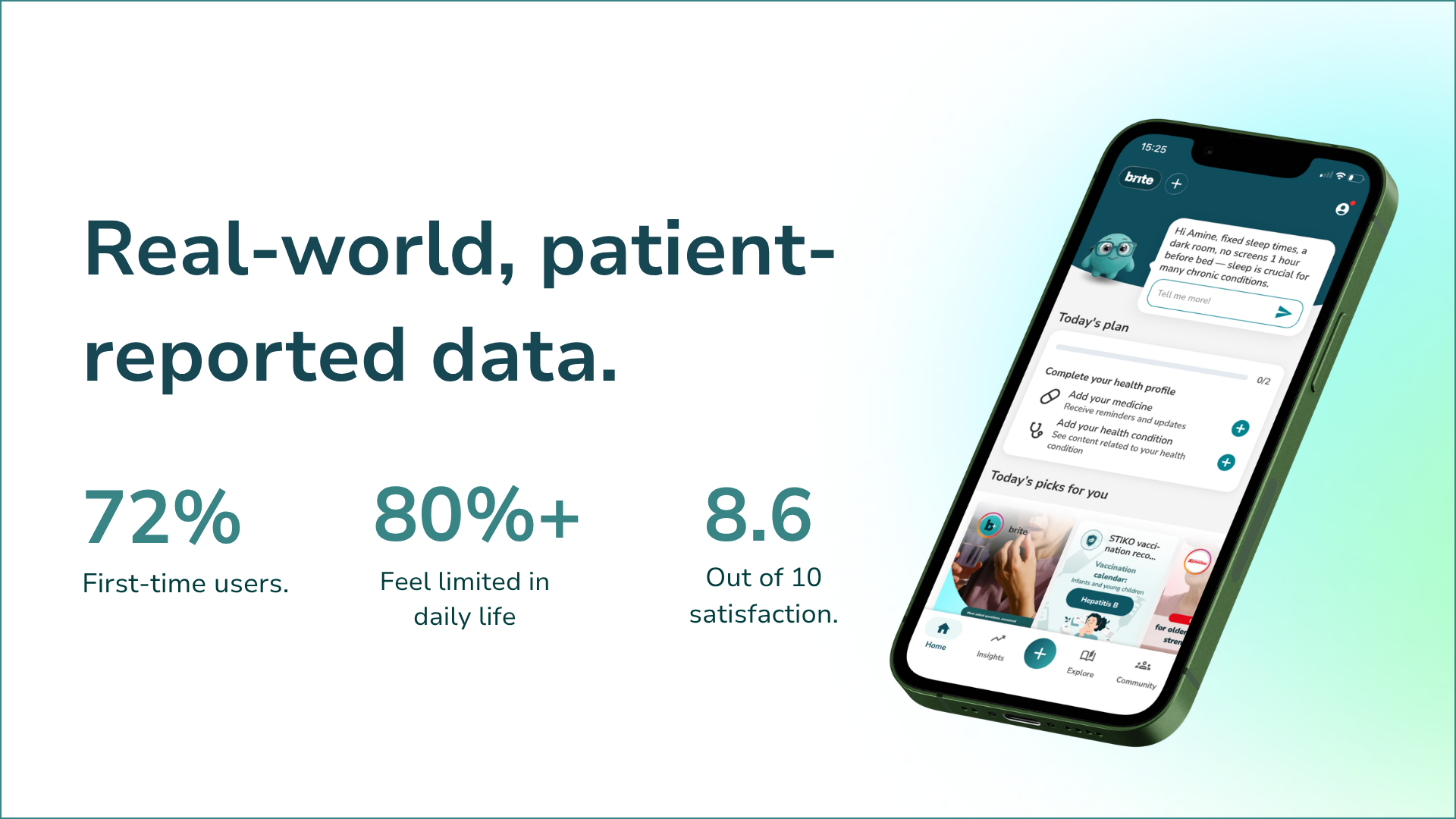
72% are taking their current therapy for the first time, and this is the most commercially significant demographic detail in the entire dataset. It means the majority of patients arrived on the platform at the most uncertain and most vulnerable point in their therapy journey, before habits are formed, before side effects are understood, and before the patient has made up their mind about whether this therapy is worth staying on. This is the window where patient support investment delivers the highest return and where its absence is most costly. A newly initiated patient who feels unsupported in the first weeks of therapy is significantly more likely to discontinue before the therapy has had any meaningful chance to demonstrate its clinical benefit.
How Patients Found the Platform
38% arrived through a physician recommendation, followed by alternative practitioners at 20% and independent internet research at 19%. The pattern here points directly to where pharma companies should be focusing their patient support investment.
The physician channel dominance is a consistent finding across brite™ therapeutic areas and it carries a direct and underappreciated commercial implication. HCP activation is not a separate workstream from patient support strategy. It is the primary driver of it. The data consistently shows that patients who arrive on the platform through a physician recommendation are more motivated, more engaged, and more likely to complete the onboarding and monitoring journey than those who arrive through any other channel. Pharma companies that invest in making it easy for physicians to recommend structured digital support as part of their standard care pathway are not just improving patient outcomes. They are building the most powerful and most cost-effective patient engagement channel available to them, one that also generates the longitudinal real-world evidence that feeds back into prescriber confidence and downstream market access conversations.
What the Appointments Were Never Capturing
The physician data tells us how patients arrived. What follows tells us what was waiting for them when they got there, and why that gap between clinical touchpoints is where the most consequential decisions in a patient's therapy journey are being made without any structured support.
Symptom severity across the cohort peaks in the moderate to moderately severe range, with a significant cluster between 5 and 8 on a 1 to 10 scale. Over 80% report some degree of everyday life restriction from their condition, with 28% describing that restriction as strong to very strong. Mental impact runs closely alongside physical impact, with 77% reporting at least some degree of psychological restriction.
This matters commercially because a patient who is significantly restricted in their daily life and feeling mentally burdened by their condition is a patient at high risk of early discontinuation. They are not failing to adhere because they forgot. They are failing to adhere because managing a chronic condition under that level of daily pressure is genuinely hard, and without structured support to help them through it, stopping feels like the rational choice. That is the revenue and outcomes gap that most brand planning models do not account for and most patient support programs were not designed to address.
None of this data exists anywhere in a standard clinical record. It only becomes visible when patients have a trusted, low-friction channel to report it continuously throughout their therapy journey, which is precisely what makes it so valuable and so difficult to generate through any other means.
The single most commercially consequential pattern here is what happens once patients leave the consultation room. This is a cohort largely at the beginning of treatment and carrying a real daily burden, which means the majority are navigating the hardest, most uncertain phase of their therapy with little support between appointments. A consultation cannot deliver the kind of continuous, contextually relevant support that managing a chronic condition in daily life actually demands, and when patients are left to fill that gap alone, adherence, confidence, and outcomes all suffer as a direct result.
For pharma commercial teams, that early, unsupported phase is not an abstract patient experience metric. It is a direct predictor of early discontinuation, reduced real-world effectiveness, and weakened evidence for the HTA submissions and payer negotiations that determine what a therapy is actually worth in the market. A patient who disengages in the first weeks is a patient who will not stay on therapy long enough to generate the longitudinal real-world evidence that proves the therapy works outside a clinical trial. Closing that support gap is not just a patient support priority. It is a commercial and market access priority.
What Engagement Actually Looks Like
Among patients who completed a therapy satisfaction check-in on brite™, the average satisfaction score was 8.6 out of 10, with 75% scoring nine or above. Patient responses cited reduced symptoms and genuinely feeling better as the primary drivers of that score.
These are not soft metrics. They are patient-reported outcomes of exactly the kind that payers and HTA bodies across Europe are increasingly requiring as part of the evidence base for pricing and reimbursement decisions. Germany's AMNOG process, France's HAS, and Scotland's SMC are all asking harder questions about whether a therapy delivers meaningful improvement in the daily lives of real patients, not just in a controlled trial setting. A satisfaction score of 8.6 out of 10 generated through validated, structured, longitudinal patient reporting is a meaningfully different asset from a post-market survey conducted three months after launch. It is the kind of continuous, credible, patient-generated evidence that feeds directly into the national HTA conversations that follow the EU Joint Clinical Assessment.
100% of patients who reached the active monitoring check-in confirmed they were still taking their therapy as prescribed. In a therapeutic area where non-adherence is a known and commercially significant problem, that figure reflects what becomes possible when structured digital support accompanies a patient throughout their therapy journey rather than ending at the pharmacy counter. It also represents a meaningful signal for pharmacovigilance: patients who are actively engaged with a structured digital platform and confirming continued therapy use are generating the kind of real-world safety data that formal adverse event reporting channels chronically underrepresent.
It is worth noting that only a proportion of the enrolled cohort has yet reached the active monitoring stage, which represents a clear and quantifiable opportunity. Every enrolled patient who has not yet reached check-in is a patient whose adherence confirmation and longitudinal outcome data remains uncaptured. Structured digital reminders and engagement nudges convert enrolled patients into active monitoring participants, and that conversion is where the real-world evidence generation compounds into something genuinely valuable for market access teams.
What Does This Look Like for Your Therapy Area?
Three conclusions emerge from this data that are directly relevant to any pharma or MedTech company evaluating patient support strategy in 2026.
The burden of chronic condition management is significantly higher than periodic clinical assessments reveal, and the patients who feel most unsupported are disproportionately those who were most recently prescribed. The data infrastructure to understand and address that burden needs to be in place from the point of first prescription, not retrofitted after launch when the most critical adherence decisions have already been made and the patients most at risk of early discontinuation have already gone.
Patient satisfaction and therapy experience data captured through continuous structured engagement is increasingly the evidence that HTA bodies and payers are asking for as the EU Joint Clinical Assessment reshapes the European market access landscape. A patient support program designed with validated patient-reported outcome instruments from the outset is a fundamentally different commercial asset from one designed primarily to drive engagement metrics. The former has a credible path toward contributing to national HTA submissions. The latter does not, regardless of how many patients use it.
The physician recommendation channel is the most powerful and most underinvested driver of patient engagement with digital support. Pharma companies that make it easy for HCPs to recommend brite™ as part of their standard care pathway are not just supporting patients. They are generating the longitudinal real-world evidence base that will underpin pricing and reimbursement conversations across every major European market, through a channel that costs a fraction of what consumer marketing campaigns require to reach the same patients.
This use case represents one therapeutic area on one cohort. brite™ currently operates across more than 40 indications with more than 40 pharma and MedTech partners. The patterns visible here are consistent and reproducible, and the data infrastructure to generate them for your specific indication is already in place. We would welcome the conversation about what this looks like for yours.
👉 Get in touch: zdenka.vesely@xo-life.com
👉 Learn more about brite™: xo-life.com/en/brite
Would you like to find out more or are you interested in XO Life?
Get in touch now, get a demo or answer individual questions in a personal conversation.
Discover even more informative articles
A selection of our latest blog posts for you.



Build meaningful relationships with your patients
Have we sparked your interest or do you have specific questions for us? Let us show you how we can brite up your patients health journey.
I am your personal contact:
Zdenka Vesely
Chief Client Officer
