

The pharma standalone app is dead. Here is what is replacing it.

In 2015, the pharmaceutical industry fell in love with mobile apps.
The logic seemed sound. Patients were spending hours on their smartphones, so why not meet them there? Company after company invested six and seven figures into beautifully designed, medically validated, brand-specific applications. Medication reminders. Symptom trackers. Educational content. Sleek onboarding flows and clinical advisory boards. On paper, it had everything a patient could need.
There was just one problem. Nobody used them.
The average branded pharma app today has a 30-day retention rate below 10%. Many fall below 5%. Users download during a launch push, open the app once or twice out of curiosity, and disappear. The carefully designed patient journeys conceived in product workshops never actually happen. Meanwhile, the maintenance costs continue, the regulatory updates demand expensive development cycles, and the competitive advantage the app was meant to create never materialises.
A decade into the mobile health revolution, the hard truth is clear. The era of the standalone pharmaceutical application is over. The companies still investing in them are burning money on a model with a well-documented track record of failure. The most forward-thinking players in the industry have already moved on.
Understanding the Failure Pattern
The app store graveyard is real and it is crowded. A quick search for any major chronic condition, whether diabetes, COPD, rheumatoid arthritis, or multiple sclerosis, returns dozens of branded applications. Most carry a handful of ratings, were last updated years ago, and survive on inertia rather than active users.
The failure pattern is consistent enough to be predictable.
There is always a download spike at launch, driven by marketing spend and healthcare professional outreach, followed by a sharp cliff. Within two to four weeks, the vast majority of users are gone. The ones who remain tend to be healthcare professionals checking out the product rather than patients using it as part of their daily routine.
The deeper issue is structural. Patients with chronic conditions do not organise their lives around pharmaceutical companies. They do not wake up thinking about a brand name. They wake up thinking about their condition, their symptoms, their family, and how to get through the day. An application built entirely around a single product has a fundamentally limited value proposition. There is only so much content a manufacturer can produce about one medication before the well runs dry, and patients sense that ceiling early.
Health apps also compete for phone space against social media, streaming platforms, messaging services, and entertainment products built by some of the world's best UX designers with enormous engagement budgets. A pharma brand application, however well-intentioned and carefully constructed, is unlikely to win that competition on its own terms.
There is also a trust dimension that branded apps have never fully resolved. Patients are increasingly sophisticated consumers of health information. They know that content living entirely within a manufacturer's ecosystem, however medically accurate, serves the manufacturer's interests. That awareness creates a credibility deficit that even excellent content cannot entirely overcome.
And then there is the cost reality that too many product teams discover too late. GDPR compliance, EU Medical Device Regulation classification requirements, Apple and Google OS updates, accessibility standards, multilingual content management, ongoing security obligations. The maintenance burden of a standalone application is substantial and never-ending. For most product teams, the app becomes a liability within eighteen to twenty-four months of launch, consuming budget that could be deployed far more productively elsewhere.
What Patients Actually Want From Digital Health
The demand for digital health engagement is real and growing. Research consistently shows that 75% of patients want digital services to support their treatment. The problem has never been patient appetite. It has always been format.
When patients describe what actually works for them, the picture is remarkably consistent. They want trusted, evidence-based information about their condition, content that helps them understand what is happening to their body, what to expect from treatment, and what is and is not cause for concern. They want a community of people who genuinely understand their experience. They want access to qualified medical expertise when questions arise. They want tools to track their health over time and share meaningful data with their physician. And they want something they can rely on continuously, not a static resource they exhaust in the first week and never return to.
None of these needs are product-specific. They are condition-specific and deeply personal. The platform that serves patients best is one organised around health and lived experience, not around a brand.
Why the Platform Model Wins
The shift from standalone apps to health platforms follows a pattern that has played out across multiple industries over the past two decades.
Nobody builds their own streaming service to distribute a single television show. They publish through Netflix, Amazon, or Spotify. Nobody builds their own marketplace to sell a single product line when established platforms with existing audiences, existing trust, and existing infrastructure are available. The platform model consistently wins because it aggregates supply, demand, and credibility in ways that no single actor can replicate independently.
Digital patient support is following exactly the same logic.
A unified patient health platform creates an ecosystem that patients have genuine reasons to use every day. Rich content across thousands of conditions, peer communities organised around shared experience, expert access, health tracking tools that integrate into real life. Within that trusted environment, pharmaceutical and medical device companies can create dedicated product spaces providing treatment-specific support for their patients. Those patients are already there. They are already engaged. They already trust the platform.
The commercial advantages compound quickly. Joining an established platform eliminates the infrastructure build entirely. GDPR compliance, MDR classification, security architecture, accessibility requirements, and operating system compatibility are all handled centrally, shared across partners, and continuously maintained by the platform. Speed to market shrinks from twelve to eighteen months down to weeks. Development costs drop by roughly 90% compared to building and maintaining a standalone application.
The reach advantage matters just as much. A platform serving patients across thousands of therapy areas attracts users at a scale that no single-brand app can approach. More users means richer community, more data, and higher return rates, which feeds back into better engagement for every product space on the platform. Every new partner and every new therapy area strengthens the value of the ecosystem for everyone already using it.
The Real-World Evidence Dividend
One of the most strategically important benefits of the platform model is the real-world evidence it generates as a natural byproduct of patient engagement, and it is frequently underestimated by pharma commercial teams.
Payers, regulators, and Health Technology Assessment bodies across Europe are placing growing weight on real-world evidence. The EU HTA Regulation, now being implemented across member states, explicitly incorporates real-world evidence into joint clinical assessments. AMNOG in Germany, HAS in France, and SMC in Scotland are all asking harder questions about whether clinical trial results translate into meaningful outcomes for real patients in real healthcare settings.
A patient who engages with a digital health platform consistently over months and years generates exactly the kind of longitudinal, patient-reported data that answers those questions. Adherence patterns, quality of life trajectories, side effect signals, and treatment satisfaction scores, captured continuously in structured formats with appropriate consent. Not retrospective surveys. Not claims data with all its inherent gaps. Genuine longitudinal patient experience at scale.
For market access teams building the evidence packages that determine pricing and reimbursement outcomes, this data is a primary competitive asset.
Pharmacovigilance, Finally Made Simple
There is another benefit that deserves more attention than it typically receives, and that is what the platform model does to pharmacovigilance.
Traditional adverse event reporting is plagued by chronic underreporting. Fewer than 10% of adverse drug reactions are ever reported through formal channels, largely because the process is complex, unfamiliar, and inconvenient for patients who are already carrying the burden of illness. The result is that safety signals surface slowly, often far later than they should.
A digital patient platform changes this fundamentally. When side effect reporting is integrated directly into an application that patients are already using, presented as a simple and natural part of their health journey rather than a bureaucratic obligation, reporting rates improve dramatically. Structured data formats and direct integration with pharmacovigilance systems make the entire process faster, cheaper, and more reliable for everyone involved.
For pharmaceutical companies managing post-marketing surveillance obligations, this is not a convenience. It is a material improvement in both regulatory compliance and patient safety.
The Transition Is Already Happening
The most patient-centric pharmaceutical companies in Europe are already operating in this model. Rather than investing in another branded app, they are partnering with platforms that offer genuine patient value and in doing so are building the kind of longitudinal patient relationships that generate real-world evidence, support adherence, and create brand affinity that outlasts any individual product campaign.
The transition is not particularly complex once the strategic logic is accepted. The content, medical materials, and brand guidelines that went into a standalone app translate directly to a platform product space. What changes is the infrastructure, the reach, and the engagement model.
The patient support arms race of the standalone app era is winding down. The winners will not be the companies that built the most apps. They will be the companies that built the most genuine patient relationships, on platforms that patients actually want to use and keep coming back to.
The model exists. The infrastructure is proven. The question now is simply how quickly pharmaceutical teams are ready to move.
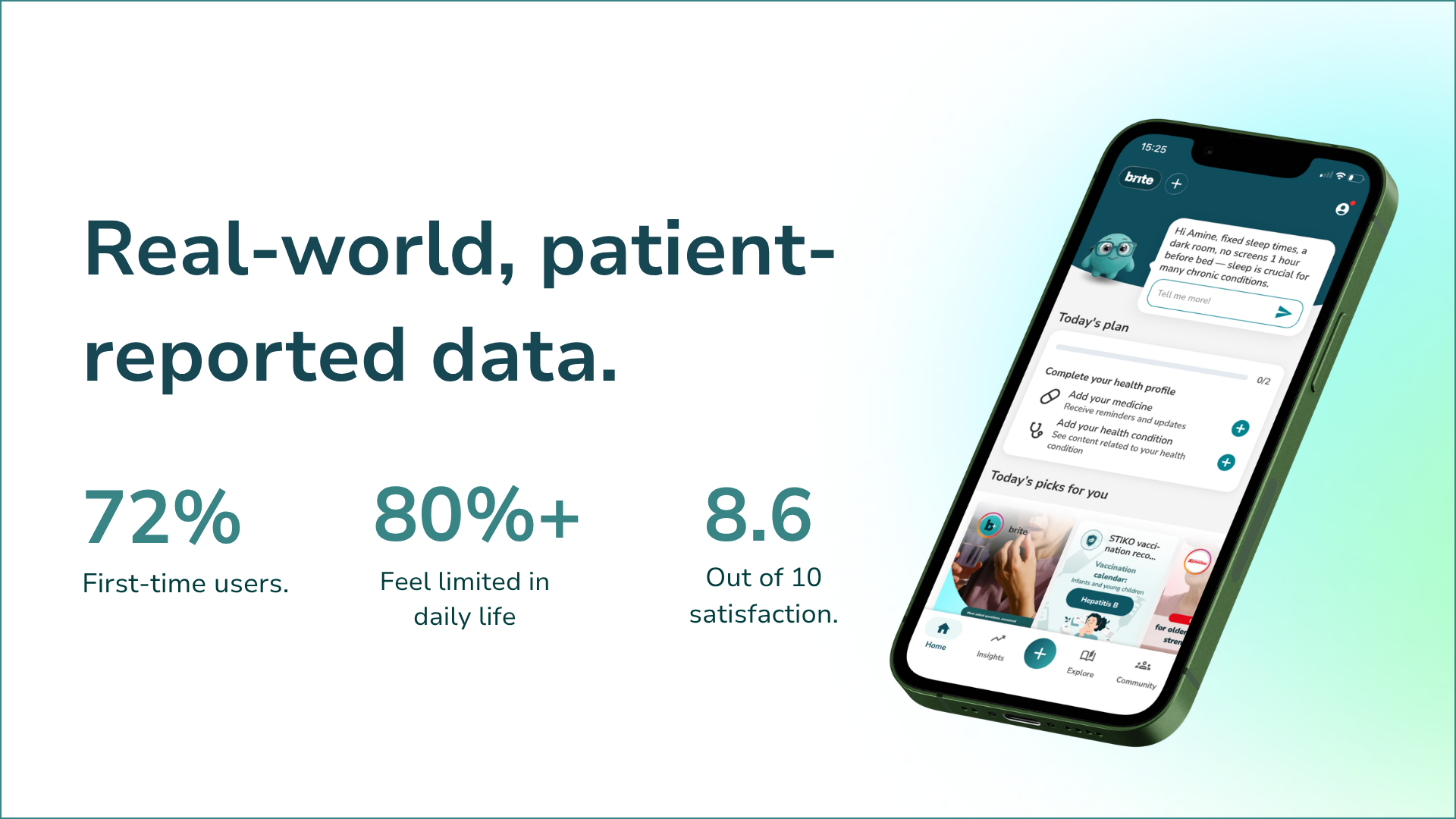
Learn how brite connects pharmaceutical companies with their patients at xo-life.com/en/brite
Sources:
https://uxcam.com/blog/mobile-app-retention-benchmarks/https://lovable.dev/guides/what-is-a-good-retention-rate-for-an-app
https://www.mobihealthnews.com/34804/survey-75-percent-of-patients-want-digital-health-serviceshttps://healthexec.com/topics/patient-care/precision-medicine/survey-75-consumers-want-digital-healthcare-services
https://pmc.ncbi.nlm.nih.gov/articles/PMC10366238/https://bpspubs.onlinelibrary.wiley.com/doi/10.1002/bcp.70491
https://www.sctinfo.com/blog/buiding-a-custom-healthcare-app/https://www.specode.ai/blog/pharmacy-app-development
https://www.specode.ai/blog/pharmacy-app-developmenthttps://techexactly.com/blogs/healthcare-app-development-cost-breakdown-by-app-type
.https://www.ema.europa.eu/en/news/new-eu-rules-health-technology-assessments-become-effectivehttps://health.ec.europa.eu/health-technology-assessment/implementation-regulation-health-technology-assessment_en
Would you like to find out more or are you interested in XO Life?
Get in touch now, get a demo or answer individual questions in a personal conversation.
Discover even more informative articles
A selection of our latest blog posts for you.


Build meaningful relationships with your patients
Have we sparked your interest or do you have specific questions for us? Let us show you how we can brite up your patients health journey.
I am your personal contact:
Zdenka Vesely
Chief Client Officer
